
Try another rooftop layout
Compare orientation, panel-row spacing, capacity, and approximate energy. Inspect the changes in 3D, then review and adopt the selected layout with undo.
Explore layout comparisons →Solar project software for installer teams in India
PVspark keeps customer details, site evidence, designs, tariff and bill assumptions, pricing, proposals, and handover records connected—so every team can pick up where the last one left off.
Built for installer and EPC teams delivering residential and C&I solar projects.
See the handoff, not a feature checklist
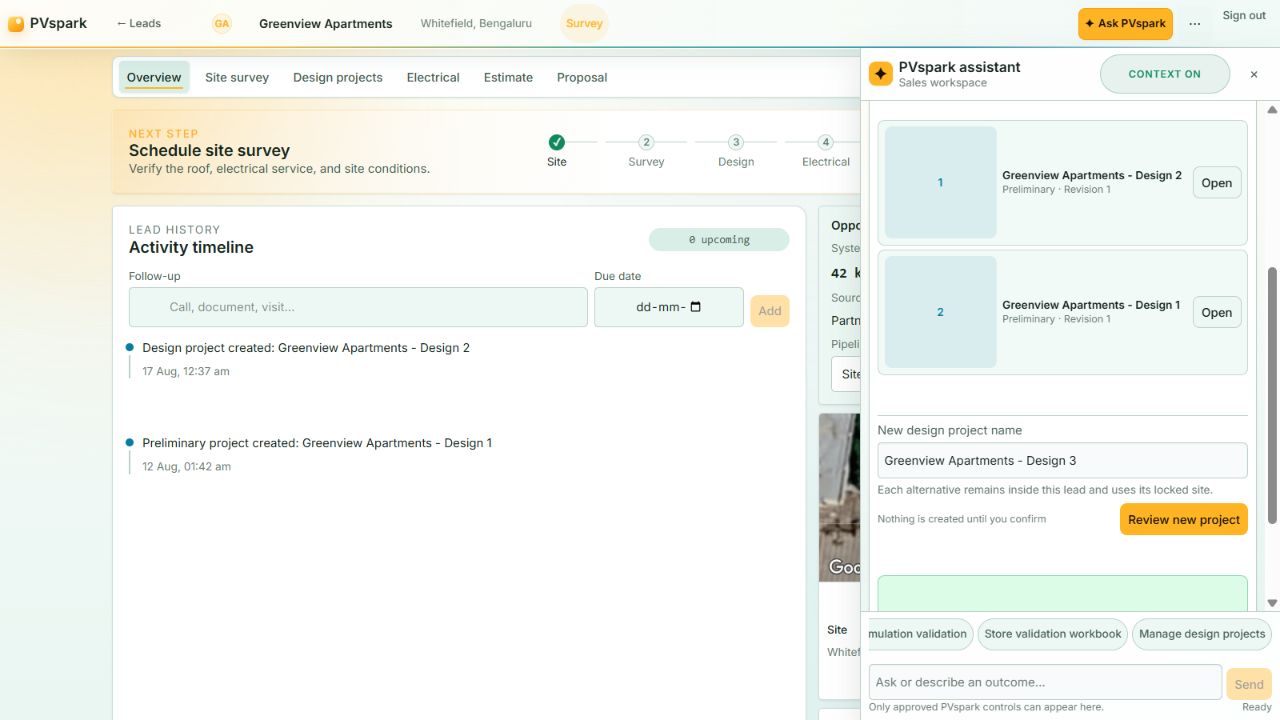
PVspark keeps the source context, current decisions, and next action connected as work moves between roles. The screens below use synthetic project data.
01Opportunity to project
Sales can schedule the survey and create design options while the confirmed customer and site context stays in view.
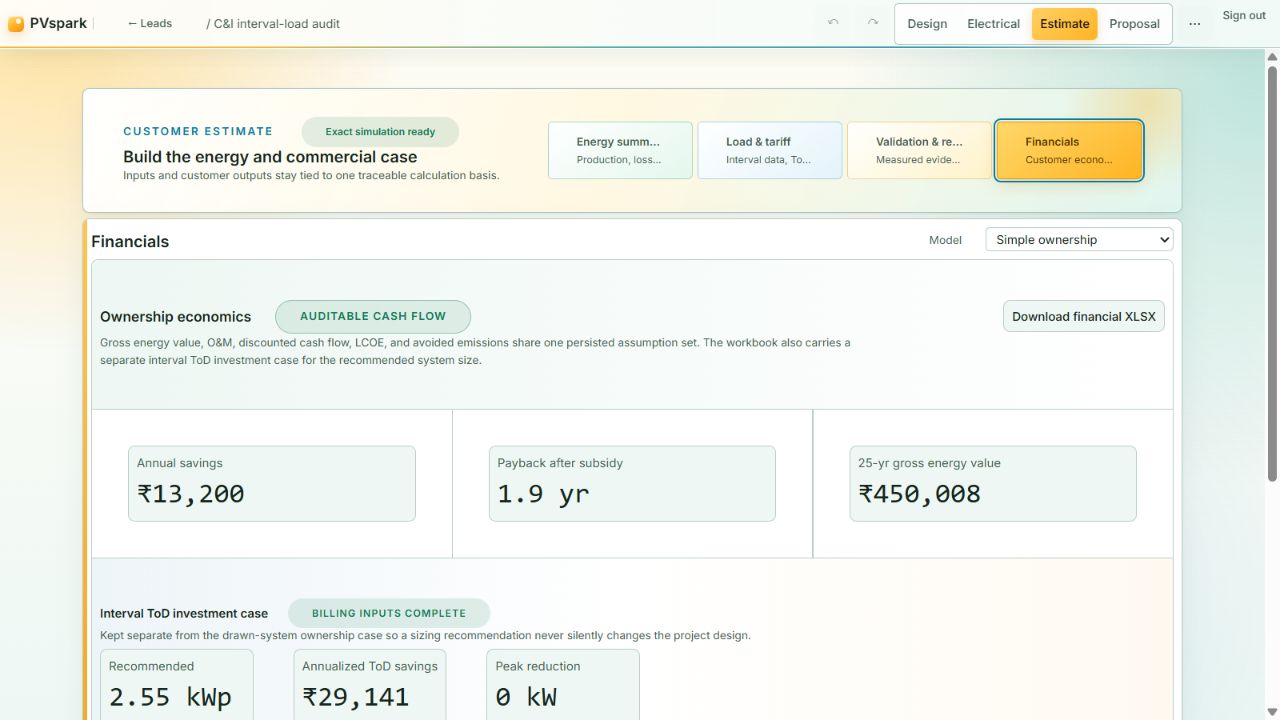
02Estimate to commercial case
Energy, interval data, ToD terms, pricing, and ownership or RESCO assumptions remain traceable to the project being discussed.
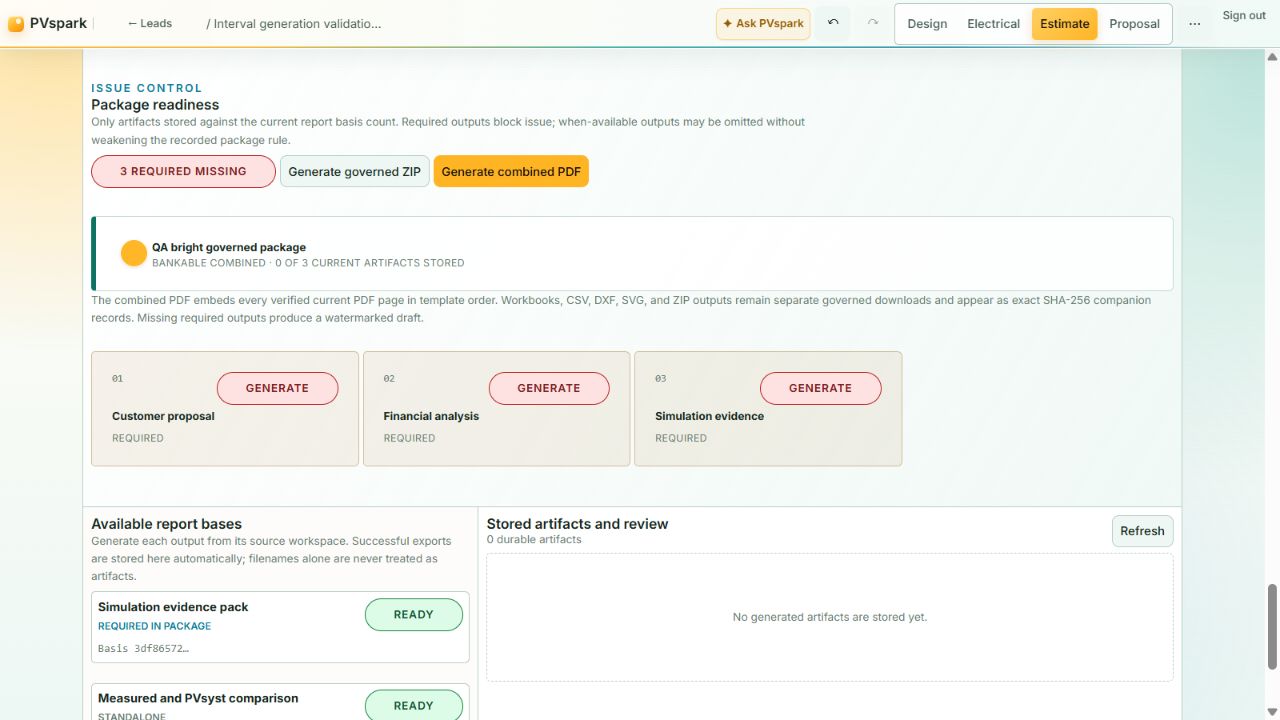
03Proposal to handover
Customer, financial, simulation, and engineering outputs can be assembled against the right revision with readiness visible before issue.
Compare before you commit
Review rooftop alternatives and ground-mount terrain proposals with the inputs, coverage, and limits alongside the result.
Compare orientation, panel-row spacing, capacity, and approximate energy. Inspect the changes in 3D, then review and adopt the selected layout with undo.
Explore layout comparisons →Save grading options, compare cut and fill, and check fixed-table clearances and height proposals over supported terrain. Keep site and engineering review in the loop.
Explore terrain studies →Compare direct sunlight before and after a grading and height proposal using the same sun inputs. This is a screening snapshot of incident light, not annual electrical yield.
Explore energy and sunlight →One project record, the full working journey
Start with the customer and site. Carry the same context through layout, electrical work, energy, tariffs, pricing, proposals, reports, and team handover.
Sales and project workflow
Give sales and delivery one solar-specific record for the customer, site, next action, survey, and design work that follows.
Site survey
Capture site conditions, measurements, electrical context, access notes, and evidence in the project where design and delivery can use it.
Solar design
Build rooftop and fixed-tilt ground-mount layouts, then compare rooftop alternatives before changing the recorded design.
Ground-mount terrain
Use recorded elevation controls to screen terrain, compare grading options, and review fixed-table clearances before adopting a change.
Electrical design
Develop stringing, circuits, routes, cable and protection screens, equipment locations, and a synchronized set of reviewable outputs.
Energy and validation
Connect shading, losses, year-long simulation, uncertainty, and measured or PVsyst comparison to the project version that produced the result.
Load, tariffs, and financials
Bring interval meter data, utility-bill evidence, reviewed India tariff options, energy results, and commercial assumptions into one auditable estimate.
Equipment and pricing
Connect a managed equipment library, approved organization price books, supplier evidence, and immutable project pricing snapshots to the BOM.
Proposals and reports
Prepare proposals, analysis workbooks, engineering companions, and branded report packages without disconnecting them from their source revision.
Team and workspace control
Manage members, invitations, roles, revisions, activity, support, API credentials, usage, and retention without opening the whole organization to everyone.
Guided PVspark assistant
Use the active lead, project, and workspace as context for readiness checks, navigation, and selected confirmed actions.
Built around Indian project evidence
PVspark brings supported interval data, utility-bill evidence, reviewed tariff options, project pricing, and financial analysis beside the solar model—without pretending every customer or jurisdiction is identical.
Explore tariffs and financials →Meter direction, CT/PT scaling, data gaps, bill reconciliation, and the tariff basis remain part of the analysis trail.
Compare the drawn system with supported load and ToD sizing views without silently changing the project layout.
Ownership, CAPEX-versus-RESCO, and sensitivity workbooks retain the assumptions that produced them.
Designed for the whole delivery team
Each role gets the workspace it needs while the customer, site, project version, evidence, and handover trail stay connected underneath.
See project status, ownership, next steps, and current handover material without rebuilding the story from messages.
Move a qualified lead into survey, design, estimate, and proposal work with the customer and site context intact.
Keep field evidence, geometry, layouts, assumptions, and named revisions in the same project trail.
Coordinate electrical outputs, load and tariff evidence, pricing, financials, and report packages.
Ask PVspark
Ask PVspark can inspect the active lead or project, explain what is ready, open the right workspace, and help with selected actions across sales, design, electrical, commercial, and reporting work.
Trust the trail, not a mystery output
PVspark keeps inputs, revisions, approvals, access, and limitations visible around professional solar work.
Named revisions and current-versus-historical report bases make it easier to see which project state produced an output.
Energy, tariff, financial, and pricing workbooks retain the evidence and calculation basis needed for review.
Organization roles, invitations, scoped credentials, audit history, and deliberate support access keep work bounded.
Supported uploads use private object storage, malware scanning, retention controls, backup, and recovery paths.
Bring PVspark into your workflow
Start with the workflow causing the most rework, then connect sales, survey, design, commercial, reporting, and handover around the same project.
We will help map roles, data, access, and onboarding so your team can adopt PVspark without losing the specialist tools it still needs.
Common questions
Start with product fit. The detailed scope, responsibilities, and access terms come before onboarding.
PVspark is built for installer and EPC teams delivering residential and C&I solar projects, particularly organizations in India that move work across sales, survey, design, commercial, and delivery roles.
Yes. Request a focused demonstration and tell us which handoff or decision matters most. Demonstrations use clearly labelled synthetic project data.
No. PVspark can begin with the handoff creating the most friction while useful specialist tools, exports, and operating practices remain in place.
No. Estimates and financial results depend on recorded inputs and assumptions. Site conditions, codes, utility rules, manufacturer instructions, and qualified professional judgement remain authoritative.
Request a demo or contact us. We will confirm the relevant workflows, roles, data boundaries, onboarding, access, support, and commercial terms before live project use.
See PVspark in action
We will show the most relevant PVspark workflow with synthetic data, answer your questions, and map the right onboarding path for your team.