
Explore rooftop alternatives
Try orientation, panel-row spacing, and capacity choices on supported roof faces. Compare approximate energy on the same basis and review any electrical reset before adoption.
Rooftop layout comparisons →PVspark product overview
PVspark gives installer and EPC teams delivering residential and C&I solar projects a connected place to qualify, survey, design, estimate, price, report, and hand work forward.
How the work moves
Each workspace is built for a different job. The customer, site, project version, evidence, assumptions, and activity trail connect them.
Qualify the opportunity, site, owner, and next action.
Capture the field evidence the next team needs.
Model the site, layout, energy, and electrical system.
Connect load, tariff, pricing, and commercial assumptions.
Prepare customer and project review material.
Issue the right package with its history and open items.
See the handoff, not a feature checklist
PVspark keeps the source context, current decisions, and next action connected as work moves between roles. The screens below use synthetic project data.
01Opportunity to project
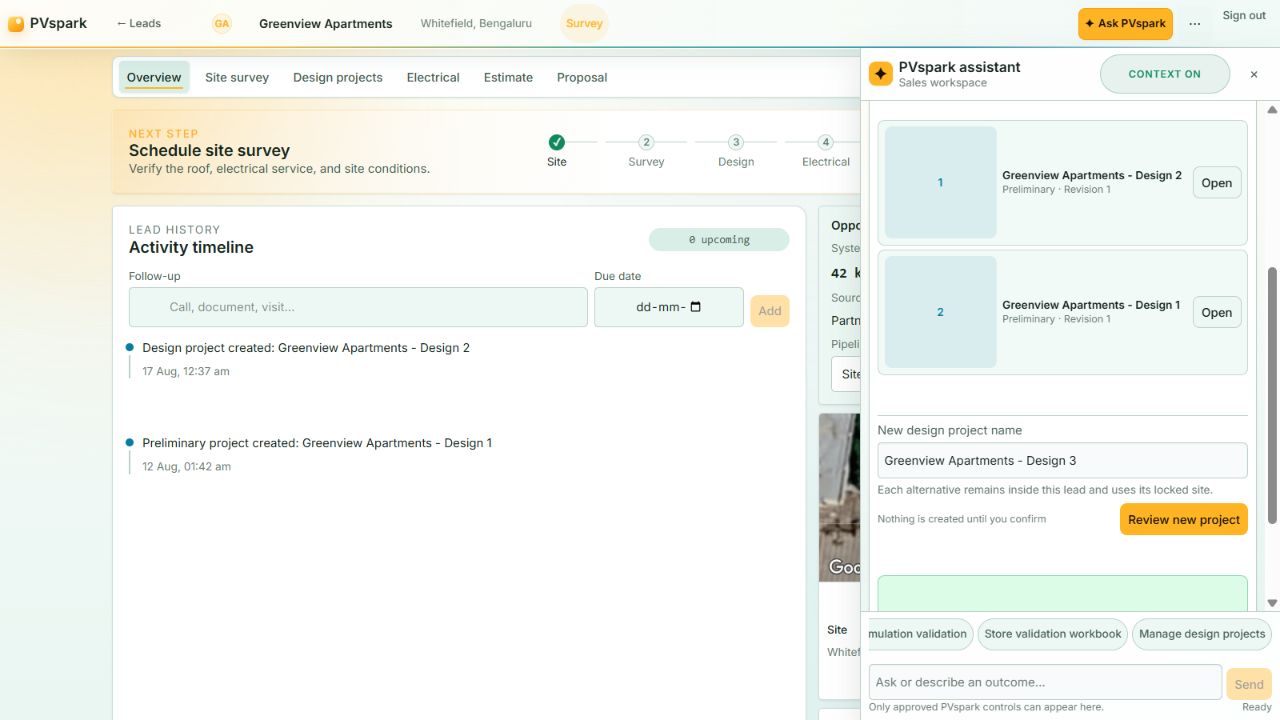
Sales can schedule the survey and create design options while the confirmed customer and site context stays in view.
02Estimate to commercial case
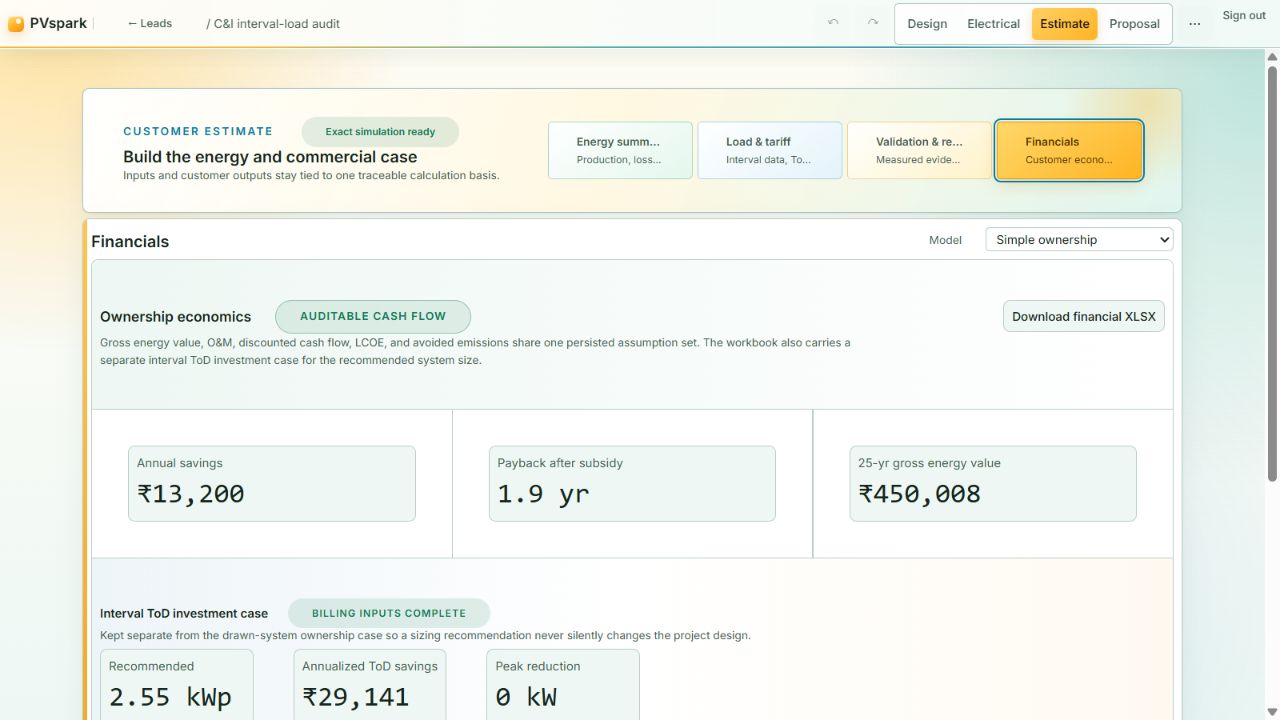
Energy, interval data, ToD terms, pricing, and ownership or RESCO assumptions remain traceable to the project being discussed.
03Proposal to handover
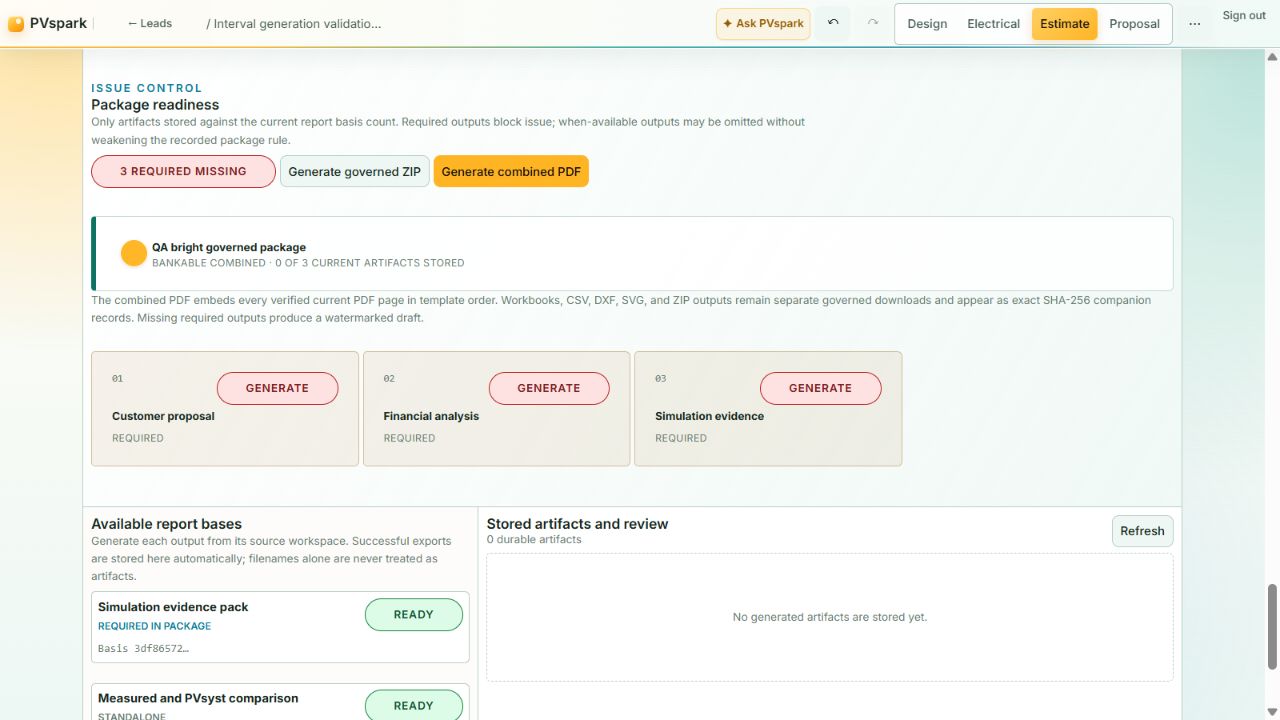
Customer, financial, simulation, and engineering outputs can be assembled against the right revision with readiness visible before issue.
A clearer design decision
Comparison and preview leave the recorded geometry alone. Explicit, undoable adoption applies a layout or eligible table-height changes. Adopting a grading plane saves its study definition and preserves the original terrain and tables.
Try orientation, panel-row spacing, and capacity choices on supported roof faces. Compare approximate energy on the same basis and review any electrical reset before adoption.
Rooftop layout comparisons →Review terrain sources and supported area, check separate elevation checkpoints, and reopen saved grading planes. Compare cut and fill, clearances, and bounded table-height changes.
Terrain and grading workflow →Inspect existing and proposed surfaces in 3D and export printable grading, clearance, and height reports. Compare instantaneous direct sunlight separately from annual energy estimates.
Energy and sunlight boundaries →Terrain and sunlight results are screening evidence. Site verification, matching survey references, project tolerances, and qualified engineering review remain essential.
Everything around the design matters
Explore the parts of PVspark most relevant to your team, from sales and field evidence to engineering, commercial analysis, reporting, and guided assistance.
Sales and project workflow
Give sales and delivery one solar-specific record for the customer, site, next action, survey, and design work that follows.
View detailsSite survey
Capture site conditions, measurements, electrical context, access notes, and evidence in the project where design and delivery can use it.
View detailsSolar design
Build rooftop and fixed-tilt ground-mount layouts, then compare rooftop alternatives before changing the recorded design.
View detailsGround-mount terrain
Use recorded elevation controls to screen terrain, compare grading options, and review fixed-table clearances before adopting a change.
View detailsElectrical design
Develop stringing, circuits, routes, cable and protection screens, equipment locations, and a synchronized set of reviewable outputs.
View detailsEnergy and validation
Connect shading, losses, year-long simulation, uncertainty, and measured or PVsyst comparison to the project version that produced the result.
View detailsLoad, tariffs, and financials
Bring interval meter data, utility-bill evidence, reviewed India tariff options, energy results, and commercial assumptions into one auditable estimate.
View detailsEquipment and pricing
Connect a managed equipment library, approved organization price books, supplier evidence, and immutable project pricing snapshots to the BOM.
View detailsProposals and reports
Prepare proposals, analysis workbooks, engineering companions, and branded report packages without disconnecting them from their source revision.
View detailsTeam and workspace control
Manage members, invitations, roles, revisions, activity, support, API credentials, usage, and retention without opening the whole organization to everyone.
View detailsGuided PVspark assistant
Use the active lead, project, and workspace as context for readiness checks, navigation, and selected confirmed actions.
View detailsBuilt to be inspected
PVspark keeps current project inputs, named revisions, calculation evidence, pricing snapshots, report state, and responsible team access close to the outputs they produce.
That makes the handover easier to review while keeping site verification, utility requirements, equipment instructions, applicable codes, and qualified professional judgement in charge.
How PVspark handles access and hosted data →See PVspark in action
We will show the most relevant PVspark workflow with synthetic data, answer your questions, and map the right onboarding path for your team.