
software evaluation
When solar installers outgrow spreadsheets and disconnected tools
Practical signs that a solar installer workflow needs stronger project records, ownership, revisions, and handoffs than spreadsheets alone provide.
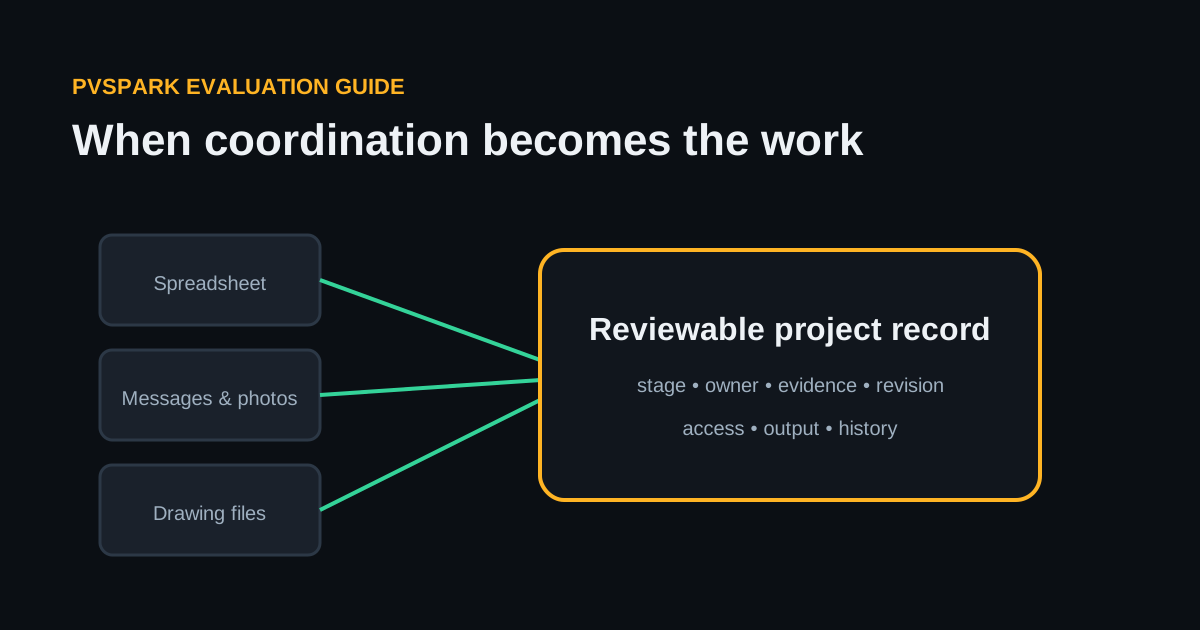
Spreadsheets are useful. They are flexible, familiar, inexpensive, and excellent for many calculations and lists. The problem begins when a spreadsheet is expected to act as the lead pipeline, customer record, survey evidence store, design register, approval system, and team notification layer at the same time.
The right moment to change is not a particular employee count. It is when the cost and risk of coordination exceed the value of flexibility.
Sign 1: nobody trusts the current status
If team members ask for the latest spreadsheet, maintain private copies, or use colours that mean different things, the file is no longer a reliable shared state.
A stronger workflow gives each opportunity or project a clear stage, owner, next action, and history. It should also show who may change important fields.
Sign 2: customer and site details are entered repeatedly
Re-entering an address, equipment choice, or capacity from lead sheet to survey form to design tool to proposal creates delay and inconsistency. Small differences become difficult to explain later.
Connected tools should reuse reviewed information while preserving the source and allowing controlled correction. Integration is valuable when it removes copying without hiding accountability.
Sign 3: evidence lives in messaging threads
Messaging tools are effective for quick coordination. They are weak as the only project record because files lose context, decisions are buried, and access can depend on individual accounts or devices.
Keep final measurements, photos, decisions, and approvals with the relevant project. Use messages to draw attention back to the authoritative record.
Sign 4: revisions are file-name conventions
Names such as final, final2, and latest-customer do not establish which design was reviewed or issued. When equipment or layout changes, teams need an identifiable revision, status, author, and reason.
Not every edit needs a formal revision. Create one at meaningful review or issue points and keep ordinary work-in-progress saving separate.
Sign 5: access is all or nothing
A shared spreadsheet or folder often gives broad access because finer control is inconvenient. As the team grows, sales, survey, design, installation, and administration roles do not need identical permissions.
Look for organization-level membership, invitations, role boundaries, audit history, and a deliberate support-access process. Test the permissions; do not accept a feature-list claim as proof.
Sign 6: reporting requires a weekly reconstruction
If pipeline, survey backlog, design status, and delivery progress must be rebuilt from several files every week, management is looking at a snapshot assembled after the fact.
Useful reporting starts with consistent operational records. A dashboard cannot repair unclear stages or missing ownership.
Sign 7: onboarding means copying someone’s personal system
New employees should not need to reverse-engineer a senior colleague’s tabs, abbreviations, and folder habits. A defined workflow makes the minimum handoff and review states visible while still allowing professional judgement.
Evaluate software against real work
Do not replace spreadsheets merely to buy a new interface. Choose two or three representative projects and test whether a candidate system can:
- move an opportunity into a project without re-entry;
- keep survey evidence attached to its context;
- support the design and energy steps you actually perform;
- distinguish assumptions from verified site facts;
- produce the outputs your reviewers and customers need;
- control roles, revisions, and invitations;
- export or recover your information;
- work acceptably under your devices and connectivity.
Also identify what specialist tools remain necessary. An integrated workspace should coordinate the workflow; it should not pretend to replace every engineering method or professional decision.
Adopt the product in stages
Begin with a clear onboarding scope, an accountable working team, and the workflow that creates the most repeated effort. Define the intended result before importing everything. Keep an export and recovery plan, compare the new process with the current one, and record where it adds unnecessary work.
PVspark supports this staged approach by connecting lead, project, survey, design, energy, output, and collaboration workflows around one project record. A focused demonstration helps teams evaluate the relevant path before discussing live access, onboarding, support, and commercial terms.