
energy performance
Understanding solar yield estimates, assumptions, and uncertainty
Learn what drives a solar yield estimate, how assumptions affect the result, and how installer teams can communicate uncertainty responsibly.
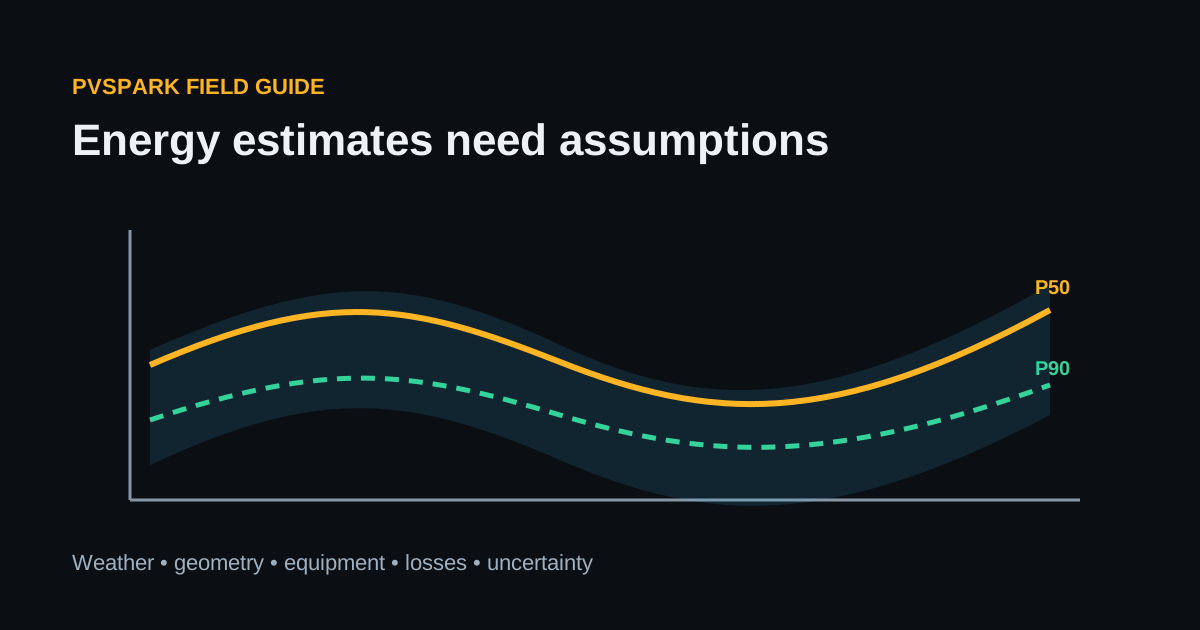
A solar yield estimate is the output of a model built from weather data, system geometry, equipment behaviour, loss assumptions, and operating conditions. It is useful for comparing designs and planning decisions, but it is not a promise of future generation.
Responsible teams make the inputs and uncertainty visible alongside the headline result. That helps a reviewer understand why two estimates differ and what must be updated when the design changes.
Start with the question the estimate must answer
An early sales estimate, a detailed design assessment, and a financing-grade energy report do not carry the same evidence or review burden. Before calculating, define the purpose, stage, time horizon, and expected reviewer.
A preliminary estimate may be appropriate for comparing two layouts. It should not be presented as though every site condition and loss has been verified.
Weather and solar-resource data matter
Models need irradiance and weather inputs for the site. A typical-year data set represents conditions constructed from multiple years; a specific historical year represents that year. Different providers, periods, spatial resolutions, and processing methods can produce different results.
Record the data source, data period or type, and any known limitations. Changing the weather source is a model revision, not a cosmetic preference.
Geometry determines the resource the array receives
Module orientation, tilt, spacing, row-to-row effects, roof planes, horizon, and nearby obstructions affect incident irradiance. Inferred roof geometry and field measurements should not be treated as equivalent evidence.
If layout or geometry changes, rerun the estimate. Copying the previous energy result into a new revision hides the effect of the new design.
Equipment models translate irradiance into energy
The module, inverter, stringing, operating limits, temperature behaviour, clipping, and electrical losses influence the modelled output. Equipment names alone may not establish that the correct model parameters were used.
Keep catalog data, selected design equipment, and simulation inputs connected. When a substitute is introduced, review compatibility and recalculate rather than changing only the proposal line item.
Loss assumptions need context
Common model categories include soiling, mismatch, wiring, availability, degradation, temperature, shading, inverter conversion, and curtailment. The relevant set and reasonable value depend on the site, equipment, maintenance, and modelling method.
A neat total-loss percentage can conceal weak assumptions. Show meaningful components, their source, and whether they are measured, specified, inferred, or defaulted.
Results should preserve scope and version
Every communicated result should be connected to:
- site and design revision;
- installed DC and AC assumptions;
- weather and model source;
- key losses and availability assumptions;
- calculation date and software or method version;
- reviewer and approval state;
- important exclusions or unresolved items.
This context makes a later update explainable. It also reduces the risk of an outdated number reaching a proposal after the layout or equipment has changed.
Uncertainty is not a single disclaimer
Future weather varies. Model equations and parameters are imperfect. Soiling, outages, maintenance, degradation, construction tolerances, and site changes can differ from assumptions. Some uncertainties can be reduced with better evidence; others are inherent in forecasting.
P50 and P90 are ways to describe annual-energy exceedance probabilities under a defined uncertainty method. They do not remove uncertainty and should not be generated from an arbitrary percentage reduction. The National Renewable Energy Laboratory’s uncertainty work identifies solar-resource variability, performance models and parameters, and system reliability among the sources that need consideration.
Communicate a yield estimate responsibly
Prefer language such as:
The model estimates annual energy under the listed design, weather, and loss assumptions. Actual production will vary, and the result should be updated when material inputs change.
Avoid turning an energy estimate into guaranteed savings. A bill outcome also depends on tariffs, consumption timing, export rules, taxes, financing, downtime, and future changes outside the energy model.
PVspark’s energy workflows keep calculation inputs and outputs within the project context and support reviewable scenarios. They aid professional work; they do not replace site verification, applicable engineering judgement, or a project-specific performance commitment.