
collaboration control
How to reduce information loss between solar sales, survey, design, and installation teams
Five operating controls that make solar project handoffs more complete, reviewable, and useful without adding unnecessary process.
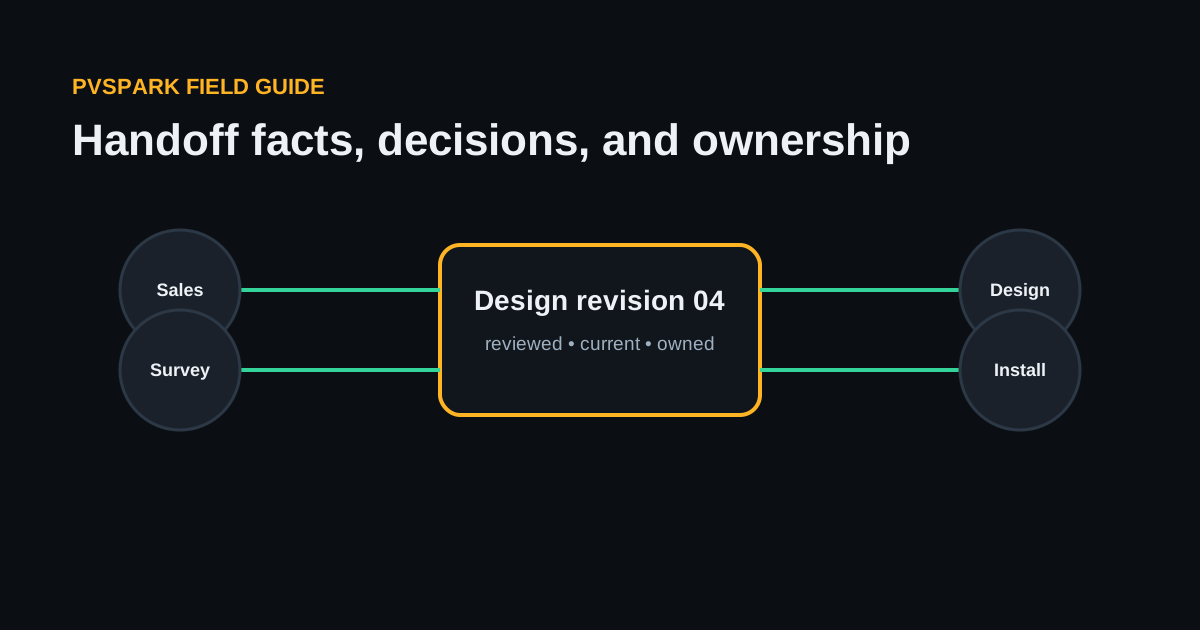
Solar sales, survey, design, and installation teams do not need the same screen or vocabulary. They do need a reliable way to transfer facts, uncertainty, decisions, and ownership.
Information loss usually appears as small operational symptoms: a designer asks for the location again, an installer receives an old layout, the customer sees a number whose assumptions are unclear, or a photograph cannot be connected to the roof face it was meant to document.
The answer is not to add a large form to every step. It is to improve the quality of the handoff.
Define a minimum handoff contract
For each transition, agree the information that must exist before ownership changes. A sales-to-survey contract might require the correct site, customer contact, project type, known access constraints, and the reason the opportunity is qualified. A survey-to-design contract needs different evidence.
Keep the contract short enough to use. If every field is mandatory, people will enter placeholders and the contract will stop communicating readiness.
Separate facts, assumptions, and unresolved questions
“Roof is clear” can mean the salesperson saw no obvious obstruction, the surveyor measured the usable area, or the designer inferred a clean plane from imagery. Those statements are not equivalent.
Label the source of important inputs. Preserve unanswered questions as first-class work instead of hiding them in a message thread.
Keep evidence beside the decision
A measurement is easier to trust when its photograph, location, author, and date remain available. A design change is easier to review when the reason and prior revision are identifiable.
Avoid using a messaging thread as the authoritative project record. Messaging is effective for attention and coordination, but the final evidence and decision should return to the project.
Make revision status explicit
Teams need to distinguish work in progress, ready for review, customer-approved, superseded, and ready for delivery. File names such as final-v7-new.pdf do not provide reliable status.
Use named revisions at meaningful review points, assign an owner, and make the current approved basis visible. Do not overwrite an approved design silently when later work begins.
Review the handoff where the work happens
Periodic process meetings often discuss general frustration. A better improvement loop samples real projects and asks:
- What did the receiving role need?
- What arrived late or without context?
- What did they reconstruct manually?
- Which field, evidence link, status, or notification would have prevented that work?
- Would the new control create more effort than it saves?
The goal is not a perfectly standardized organization. It is a shared record strong enough that each specialist can see what is known, what was decided, and what they still need to verify.