
energy performance
P50 and P90 explained for solar teams
A practical explanation of P50 and P90 solar energy values, the uncertainty assumptions behind them, and the mistakes teams should avoid.
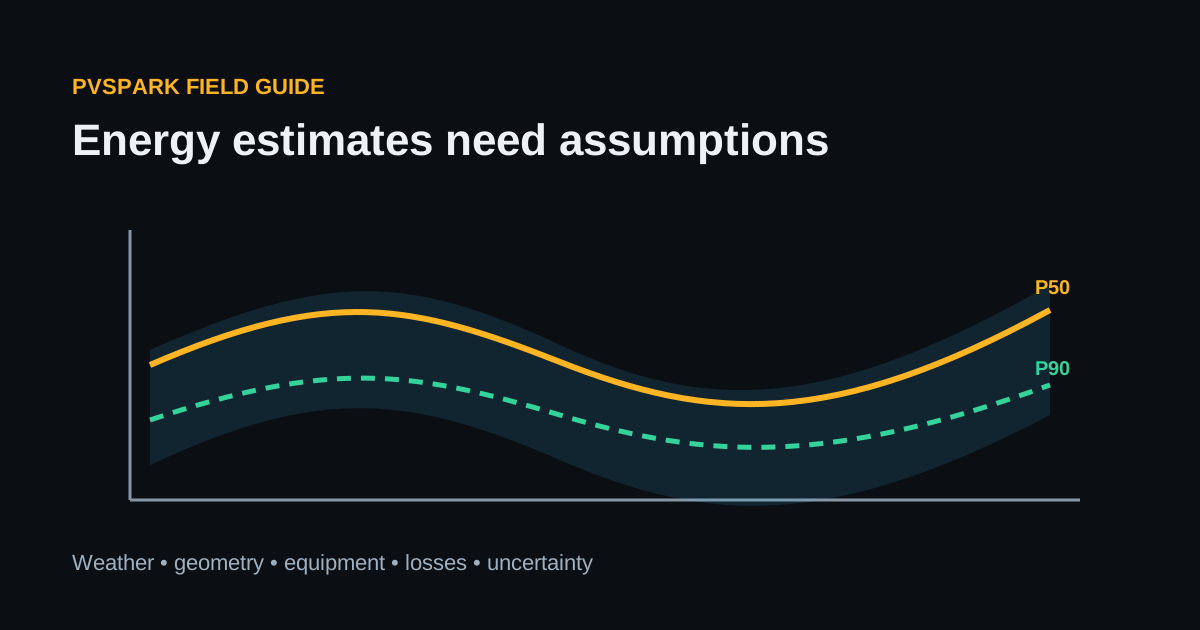
P50 and P90 are annual energy values tied to an exceedance probability under a defined model. In plain language, a P50 annual value is expected to be met or exceeded in 50% of future years, while a P90 value is expected to be met or exceeded in 90% of future years.
That definition is simple. Producing a defensible number is not.
P50 is not a perfect forecast
P50 is often close to the central or expected annual estimate when suitable multi-year weather information is used. It remains dependent on the design, model, resource data, loss assumptions, and interpretation of uncertainty.
P50 does not mean the project will generate exactly that amount next year. A particular year may sit above or below it.
P90 is a more conservative exceedance value
P90 is lower than P50 when uncertainty is represented in the usual way. The gap depends on the estimated distribution and combined uncertainty, not on a universal discount.
P90 does not mean “90% of P50,” and it does not mean that 90% of every month or day will achieve a scaled target. PVsyst’s current P50-P90 documentation specifically treats the method as a probabilistic interpretation of annual results and cautions against simply scaling hourly values by the annual P90-to-P50 ratio.
The uncertainty method drives the answer
A calculation needs a central annual-energy value and a justified representation of variability and uncertainty. Depending on the method and project, contributors can include:
- interannual solar-resource variability;
- resource-data uncertainty or bias;
- module and model parameters;
- shading and soiling assumptions;
- availability and reliability;
- construction and operating differences;
- other project-specific uncertainty.
Do not add unrelated uncertainty values casually. Some contributions are correlated, some describe bias rather than random variability, and some belong in a different risk analysis.
One year of weather is not automatically enough
A simulation based on one historical year describes that input year. It does not by itself establish the long-term distribution needed for a reliable P50 or P90 interpretation.
The data period, representativeness, and method should be documented. The National Renewable Energy Laboratory describes P-values as annual energy values exceeded in future years with the stated probability and notes the need for transparent best practices; see its report on quantifying uncertainty in PV energy estimates.
Use P-values for the right decision
P-values can help compare annual-energy risk, support financial analysis, and communicate that one deterministic result does not capture future variability. Their value depends on the decision being made and the quality of the inputs.
For a small early-stage rooftop opportunity, a complex P90 calculation based on weak assumptions can create false precision. A clear preliminary yield range and assumption list may be more honest. For a project where financing or contractual decisions depend on downside energy, the review standard may be much higher.
Review these questions before sharing P50 or P90
- What annual energy result is being interpreted?
- Which weather data and period support it?
- Which uncertainty sources are included or excluded?
- Does the method assume a particular probability distribution?
- Is the value annual, and is anyone incorrectly applying it to shorter intervals?
- Which design revision and equipment set does it represent?
- Who reviewed the method for this decision?
- How will the result be described in the proposal or report?
Suggested communication language
State both the meaning and the boundary:
Under the documented model and uncertainty assumptions, P50 and P90 are annual energy exceedance values. They are probabilistic estimates, not guaranteed production, savings, or performance.
If the assumptions are not strong enough for that interpretation, do not solve the problem with a stronger disclaimer. Improve the evidence, narrow the use, or omit the P-value.
PVspark includes workflows for energy analysis and P50/P90 scenarios where configured inputs support them. A qualified reviewer remains responsible for choosing assumptions and deciding whether the result is appropriate for the project.